

BA LLB vs BBA LLB: Which Integrated Law Degree is Right for You?
Choosing a career in law is an exciting decision, but for high school graduates in India, it immediately brings up a critical question: Should I choose a BA LLB or a BBA LLB?
Both are elite, 5-year integrated undergraduate honors programs approved by the Bar Council of India (BCI). Both save you a full year compared to doing a traditional graduation followed by a 3-year LLB. However, their academic focus, campus experience, and ultimate career destinations are fundamentally different.
If you are looking at top BA LLB colleges or weighing your corporate law options, this comprehensive breakdown of the difference between BA LLB and BBA LLB will help you make the perfect choice.
Eligibility & Admission
For those researching the 5-year integrated law course eligibility criteria in India, requirements typically include a minimum percentage in class 12 from a recognized board. Many students search for colleges accepting class 12 marks for law admission as an alternative to standardized testing, emphasizing the importance of checking individual institution policies.
1. The Core Academic Difference: Course Curriculum
The primary difference between the two tracks lies entirely in the non-law papers you study during your first three years.
BA LLB (Hons)
This program blends core legal training with the Humanities (Arts).
Key Non-Law Subjects: Political Science, Sociology, World History, Economics, and English Literature.
The Focus: Understanding law through the lens of societal structures, historical contexts, and governance frameworks.
BBA LLB (Hons)
This program blends core legal training with Business Administration (Management).
Key Non-Law Subjects: Principles of Management, Financial Accounting, Organizational Behavior, Human Resource Management, and Strategic Management.
The Focus: Understanding law through the lens of corporate strategy, business operations, and financial markets.
Note: The core law papers (such as Constitutional Law, Law of Torts, Law of Evidence, and Criminal Procedure Code) remain identical and mandatory for both streams.
2. Career Prospects: Corporate Law vs. Litigation
Your choice of degree heavily influences your initial career trajectory upon graduation.
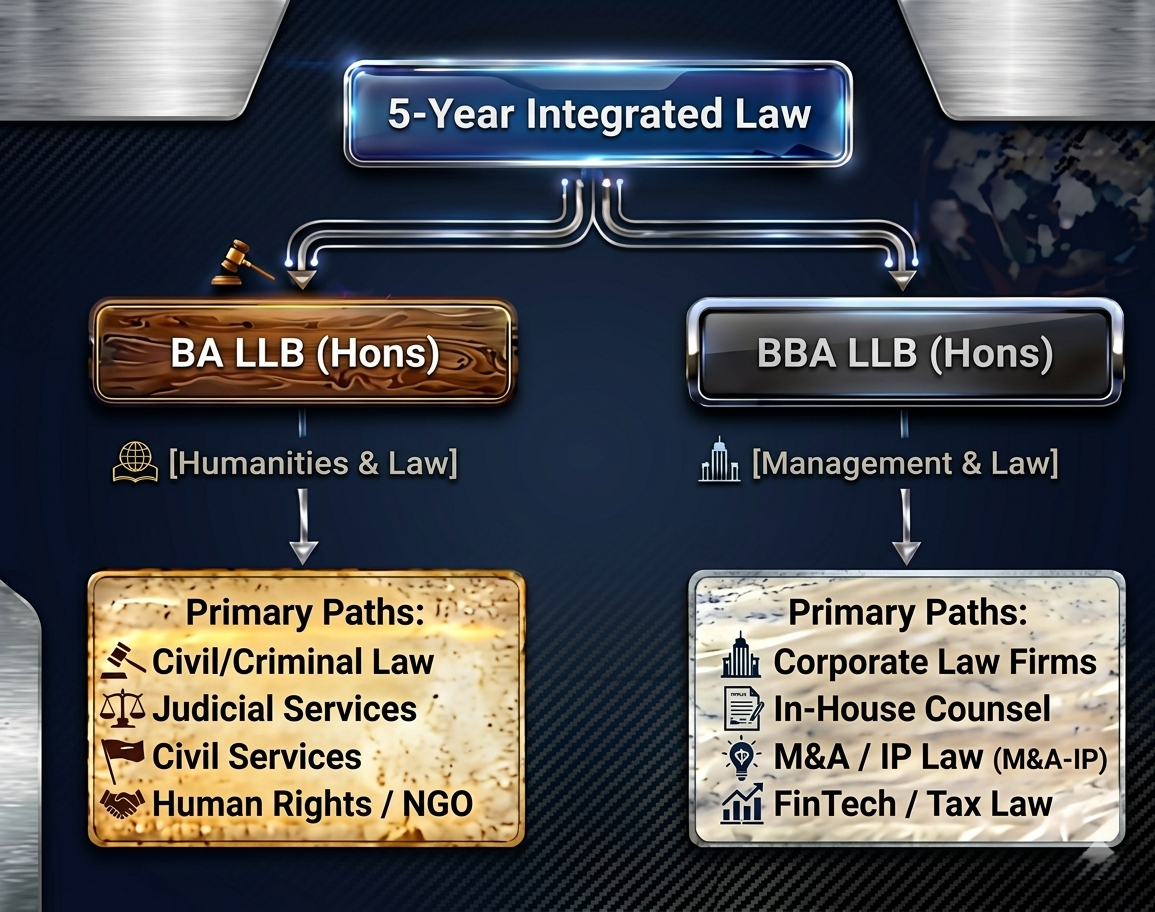
The Litigation & Public Service Path (Leans BA LLB)
If your dream is to argue in constitutional courts, practice criminal defense, or join the judiciary, BA LLB provides a strong foundational base. The deep grounding in political science and sociology assists significantly when preparing for the Judicial Services Examinations or the Civil Services (UPSC).
The Corporate & Boardroom Path (Leans BBA LLB)
If you want to work for major multinational companies, international tech giants, or top-tier corporate law firms, BBA LLB gives you an immediate competitive advantage. Because you already understand balance sheets, corporate restructuring, and human resource frameworks, corporate employers spend less time training you on business basics. This path is ideal for fields like Mergers & Acquisitions (M&A), Intellectual Property Rights (IPR), and Corporate Compliance.
3. How to Choose: The Decision Matrix
Still undecided? Ask yourself these three defining questions:
- What naturally interests you? Do you enjoy debating political theory, history, and social reforms? Go with BA LLB. Do you find corporate strategies, stock markets, and how business systems run more fascinating? Go with BBA LLB.
- Where do you see yourself working? If your ideal workplace is a courtroom, a public policy think-tank, or a government office, choose BA LLB. If it’s a high-rise corporate office or a commercial law firm, choose BBA LLB.
- Do you have an entrepreneurial mindset? If you plan to start your own legal consultancy firm down the line, the business management principles taught in BBA LLB will prove invaluable.
Experience Both Worlds at Xavier Law School (XIM University)
Rather than forcing you into a corner, premier institutions give you elite choices for both career trajectories. Xavier Law School (XIM University) provides world-class infrastructure for both tracks right in the heart of Odisha’s educational hub.
Whether you choose the Integrated Law Programs for BA LLB (Hons) or BBA LLB (Hons), you gain access to:
A modern Bar Council of India (BCI) approved 10-semester curriculum.
Rigorous practical training via regular Moot Court settings and mandatory internship modules.
An advanced Academic Information System (AIS) to track assignments, project works, and clinical legal courses smoothly.
If you are seeking a 5 year admission process for a law college in East India that offers a holistic learning environment, Xavier Law School stands out. For students looking for CLAT alternative law colleges in Odisha, XIM University offers a distinct path that balances theoretical law with practical corporate management.
Ready to take the first step? Explore the Integrated Law Programs at Xavier Law School and apply online today.
Frequently Asked Questions (FAQs)
Q1: What is the main difference between BA LLB and BBA LLB?
The key difference is the non-law papers studied. BA LLB integrates law with humanities subjects like Political Science and Sociology, while BBA LLB combines law with business administration subjects like Accounting, Finance, and Management.
Q2: Which course is better for corporate law, BA LLB or BBA LLB?
BBA LLB is generally considered better suited for corporate law. It covers essential business topics like corporate strategy, financial management, and organizational behavior, giving graduates a distinct edge in corporate legal departments and commercial law firms.
Q3: Can a BBA LLB graduate practice in a courtroom?
Yes, absolutely. Both BA LLB (Hons) and BBA LLB (Hons) are fully recognized professional law degrees. Upon passing the All India Bar Examination (AIBE), graduates from either stream can practice litigation in any court across India.
Q4: Is math compulsory for taking admission into BBA LLB?
No, mathematics is generally not a compulsory requirement at the 10+2 level for entering a BBA LLB program, though basic logical and analytical reasoning skills are helpful for entrance exams.
Q5: Which degrees are offered under the integrated law programs at Xavier Law School?
Xavier Law School at XIM University offers parallel 5-year integrated undergraduate courses: Bachelor of Arts & Bachelor of Laws (Hons) [BA LLB (H)] and Bachelor of Business Administration & Bachelor of Laws (Hons) [BBA LLB (H)].
Q: Are there alternatives to CLAT for law admissions in Odisha?
A: Yes, many private universities, including XIM University, conduct their own selection processes, making them viable CLAT alternative law colleges in Odisha for students pursuing an integrated law course in India.
